Tennis elbow without tennis: outer elbow pain and how tendons respond to load
Sharp pain on the outside of the elbow when gripping, carrying a bag, opening a jar or holding a mouse — and no tennis anywhere in the story. Most people who get tennis elbow have never played. It usually improves over months, and the practical questions are how to keep working, how to load the tendon sensibly, and what to do when it flares.
What is actually going on
Tennis elbow involves the tendon that anchors the wrist extensor muscles to the outside of the elbow. Despite the older name epicondylitis, the tissue changes are more about a tendon that has not kept up with what it is being asked to do than about ongoing inflammation. Symptoms alone cannot diagnose it — several problems produce pain in the same area — so an in-person examination is what separates a tendon problem from a joint, nerve or neck-referred one.
How it usually behaves
- Pain on the outside of the elbow when gripping or lifting
- Pain opening a jar, wringing a towel or turning a key
- Aching spreading down the forearm after computer or tool use
- Tenderness when pressing just below the bony point of the elbow
- Weaker grip because gripping hurts, rather than because the muscle has failed
It often builds gradually after a change in workload rather than after one incident. Other possible causes overlap here: radial nerve irritation, elbow joint problems and pain referred from the neck can all feel similar, which is why testing beats assuming the obvious label.
What an assessment looks at
The starting question is what changed: new tools, a new job, a heavier training block, a heavier load to carry, or a different keyboard. Then grip, wrist and forearm strength are tested, the tendon loaded in a controlled way to confirm it reproduces your pain, and the elbow joint, the nerves of the forearm and the neck checked. That breadth is not thoroughness for its own sake — it changes what would be recommended.
What a plan may involve
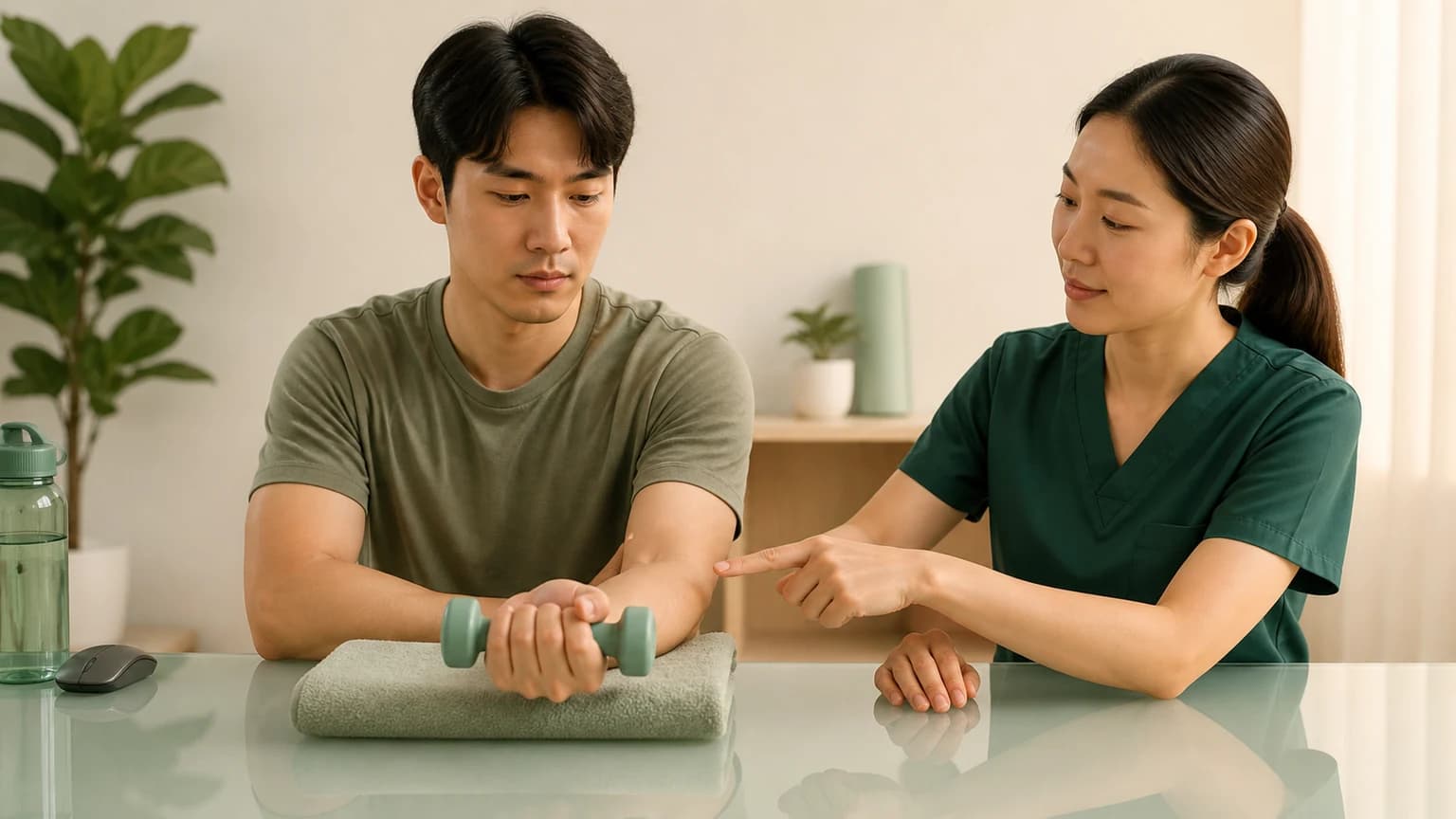
Tendons generally respond to load that is progressive and repeatable, so graded strengthening for the wrist, forearm and grip is usually central, alongside temporary changes to the tasks that irritate it most. Depending on the assessment, a strap or brace, hands-on treatment or acupuncture may be considered where you consent and where they seem likely to help you tolerate the exercise. Your preferences and job demands shape the order. There is no fixed routine, and the plan is adjusted according to how you respond.
What you can do day to day, and how progress is judged
Complete rest often feels good for a fortnight and then disappoints, because the tendon loses capacity while the job stays the same. The more durable approach is to lower the peaks — carry with two hands, split heavy tasks, change grip size — while adding controlled loading. How much next-day soreness is acceptable gets agreed explicitly, a flare-up plan is set out, and grip comfort, strength and daily activity tolerance are reviewed at each visit before the load changes.
When to have it looked at medically
Most outer elbow pain is well suited to a physiotherapy assessment and a graded loading plan. Arrange a prompt medical review instead if the elbow is hot, swollen and you feel feverish; if pain began after a fall or direct blow and the joint will not straighten; if you have unexplained weight loss; or if you are losing grip strength in a way that is clearly getting worse rather than simply painful. Go to an emergency department the same day if the arm was injured and you cannot use it, if the elbow looks out of shape, or if the hand becomes cold, pale or increasingly numb.
If this sounds like your situation, WhatsApp or call us to arrange an assessment.
Outer elbow pain when gripping, lifting or using a mouse? We assess the tendon, the forearm and your daily load, then build a graded plan you agree with rather than open-ended rest.
Lower back pain that limits sitting, bending, work or sleep? Our Yau Ma Tei physiotherapists assess your symptoms, movement and daily load, then agree an individual plan with you.
Neck pain, a stiff neck or headaches linked to neck tension? Our Yau Ma Tei physiotherapists assess your symptoms, movement, work setup and sleep before agreeing a plan with you.
Assessment-led, hands-on physiotherapy to support comfort and movement. WhatsApp us to arrange an appointment, or call us if that is easier.